Muka
From my early childhood I was fascinated by cars. It has been said that "brm" was the very first word I uttered. In the family photo-album there's a photograph of me, taken when I was just a few years old, going through the newspaper. The caption for that photo reads: "Is there a 'brm' in here?"
As far as I can remember I drew pictures of cars since when I was six or seven, around 1976. Those were not pictures of existing cars, and I immediately had to ask myself what cars they were. So I devised the factory and car-brand Muka, just like I had devised the appearance of the cars. I made up a history of the brand in 1978, so Muka predates geofiction (my fictitious countries). For many years I myself was the chairman of the board of directors as well as the chief designer, but from around when I was twelve I was just one of the directors, and later I resigned or had never even been a director.

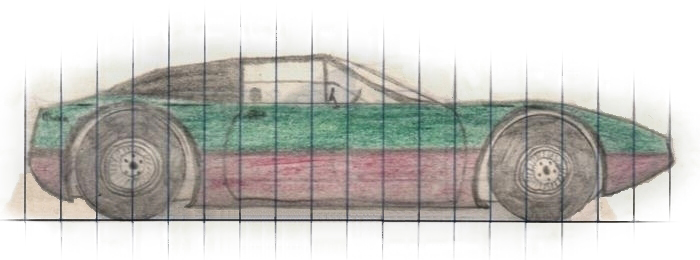
Muka Ventoux prototype. I made this drawing when I was twelve. I never coloured in another drawing.
From the very first start the Muka-factory was in Lexmond, on the very spot of the station for AI my father worked at as a veterinarian, right next to our home. So obviously this AI-station did not exist in the parallel reality I had created. The area of the Muka car-factory was bigger, the building looked quite different, and other people worked there than the people that worked at the AI-station. I was never surprised by the fact that by making up a car-factory I had created a parallel reality. The family Uwland had througout the history of the factory been directors and designers for Muka. The name Tireveld only came into existence around 1993 or 1994. Other old names were Hans Bakker, Joop Beyaart, Paul Dubois, Donald Smith, Koos Westendorp, Leen Verhoef and Irene de Vries (also their careers in Muka have hardly changed).
At first I devised that Muka had started to build cars in 1898, under the name of Ura, and the first car was called Ura Sliroot. One of the problems I needed to solve was that it was highly unlikely the founder of Muka would have had the same initials to be able to lend them to the name of the brand. Other than Ura the factory in those first years also has been called Huka. Later versions of the history named 1922 and for a small peiod of time even 1945 as years the factory had been founded, and the first-built models in those cases were the 812 and Lennox respectively.
Around 1982 I made the definitive choice to have the car-factory founded in November 1901, without any name-changes. The first-built model would then be the Muka 3600. In September and October 1983 (it was four months after my mother had died) I drew a complete history of all types the factory had built, from the 1902 Muka 3600 until the 1983 Ventoux. The latest version of Muka's history is still based on this document. All those years the history of the factory was written of the basis of the (many books filled with) drawings of the cars. Krelis' death in 1902, the workers-strike in 1922, the explosion of the factory in 1940, and the accidents in formula one racing in 1980 are all old stories. The oldest car-types I drew and that are still part of Muka's history are the 130, the Redondo ('Boordevol' in Dutch) and the Hustler.
In the beginning of the eighties I started to dedicate more time to my fictitious country Vixati than I did to Muka. Vixati had started in 1982 and grew to be very extensive in 1983. Because Vixati's location had never been fixed definitively and because Muka had grown to be synonimous to the village of Lexmond, the two have never been combined. Vixati had its own car-factory, called Ixalth. Around 1987 my many daily pursuits made that both Vixati and Muka came to a halt. Vixati was abandonded (and succeed by Estave and from 1990 on by Ubilan), but Muka awoke again later in 1990, at the time of (and inspired by) my temporary job at Mercedes-Benz. Both the way I described Muka and its outward appearance changed in the nineties, just like my fictional country did. Muka no longer was propelled by the car-drawings I (ever more seldomly) made, but more by the many stories about its history that already were in existence. I had moved to live on my own in Utrecht (1 October 1988), and Muka stayed behind in Lexmond.
I hardly worked on Muka in 1990 en 1991, although it was still in existence. In November 1991 I started to write a new version of Muka's history. But all those years my fictitious country Ubilan in Gmune was much more important and took up more of my time than Muka did. In a way Ubilan (preservation of the environment) and Muka (destruction of the environment) worked against eachother. It was only after Ubilan around the end of 1995 had ended that I, more or less by default, dedicated enough attention to Muka to expand it to many hundreds of pages of text. In the beginning of 1996 Muka's history comprised a total of 162 pages, but this had grown to 712 pages only two years later.

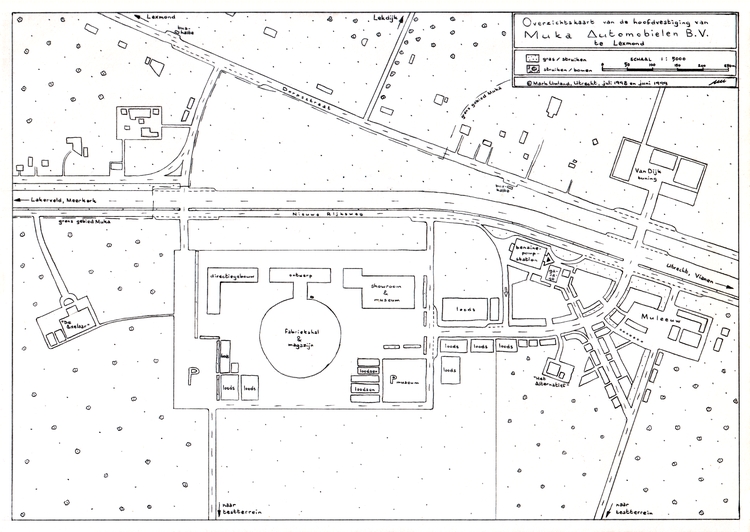
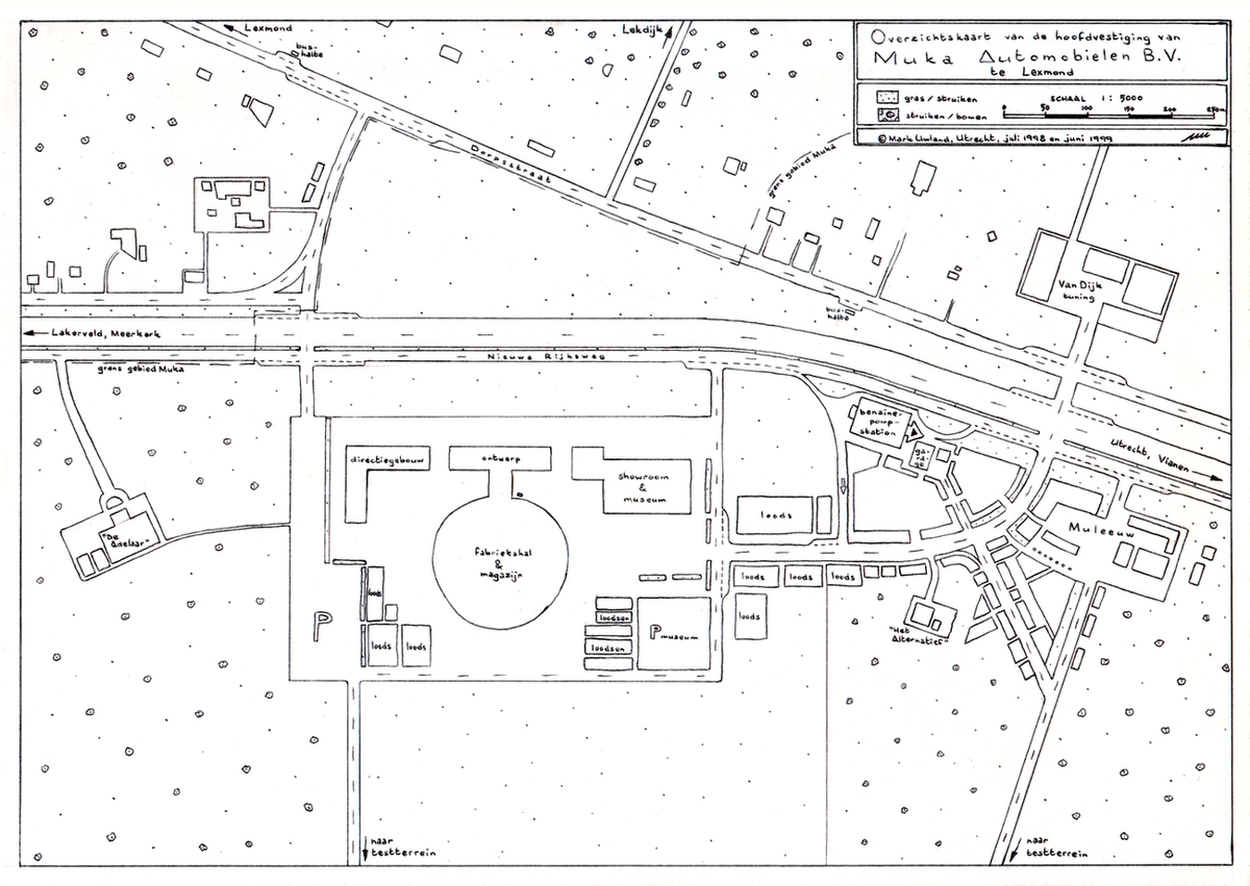
Map of the Muka car-factory in Lexmond. Click to download a version of 612 KB.
In general I try to write stories that might have happened in real life. But even more so than in my fictitious countries it is hard to fit Muka in to reality, if only because Muka is on this Earth, as opposed to the fictitious countries. It has been my conscious decision to not change the major part of the information about Muka that I defined when I was a kid, including names and appearances of the car-types and the years they were built, the numbers in which they were built, and the names and ages of the Tireveld family members and some of the other directors and/or designers, even though this old information does not make a reader able to imagine it might have really happened in that way. Later I added a good deal of memories from my youth to the stories, without caring about Muka being realistic.
In a way Muka mirrors Bugatti, and Henk Tireveld is an alter ego of Ettore Bugatti. I vividly remember my frustration in my youth when I discovered that the information I was searching for couldn't be found in any of the many books I possessed about Bugatti, that is an extensive history of the brand Bugatti, a biography of the owner Ettore, and a summary of the number of cars built each year, per type (the most beautiful one of the books had a table with per type the number built, the numbers that survived to this day, and their current homes per country). The more pages I read, the less information I found and the more details I made up about Muka. Muka is a complement to reality.
In my life I can only experience the things that actually come along. The only way to acquire new knowledge is through previously gained knowledge and skills. All following years are based on the previous years, new ways for old experiences to represent themselves to me. Formulated thus, my life is an amplification of my youth and education, that both continue until I die. Muka is no more and no less than a sublimation of some of my childhood memories, and because of that is void of pretentions, is necessary as a means to flee, is useful to focus upon and is fun as a pastime.
Utrecht, November 2000
Muka
Photos
Other
to the top of the page