 Cars
Cars| page 1 | (go to cars page 2 or go to cars page 3) |
Ever since I was a very little child I was fascinated by cars. Since around the beginning of 2006 I regularly search the web for pictures of beautiful automobiles. To me the most interesting period of automobile-building was from around 1919 until around 1955. On these pages I show some cars I think are beautiful or special. I hardly know a thing about them (that was completely different when I was young).
These photos are not made by me, unless otherwise noted.
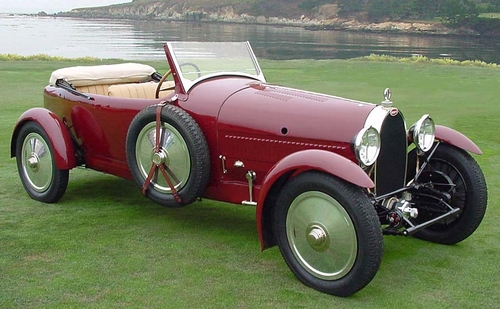
I have always thought Bugattis were very beautiful, and I loved the history of the brand, that was owned by the eccentric founder of it, Ettore Bugatti, an Italian who migrated to France. Bugattis were built in the village of Molsheim in Alsace, and when in 1947 Ettore died, the history of the brand ended with his life (although there have been many attemps to revive the brand). This picture, judging by the background, was made at the Pebble Beach concours, at the west coast of the United States. I think there really is no door on the driver's side.
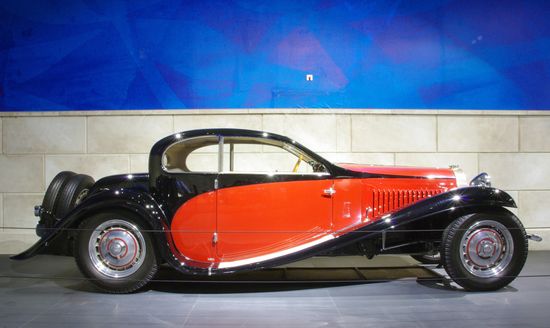
This car is in the Louwman Collection in Den Haag. A classical design. One really needs to view this car from the side. It's not easy to find good pictures of cars, taken from the side. It appears there's a general preference for pictures taken from the front. I took this picture myself.
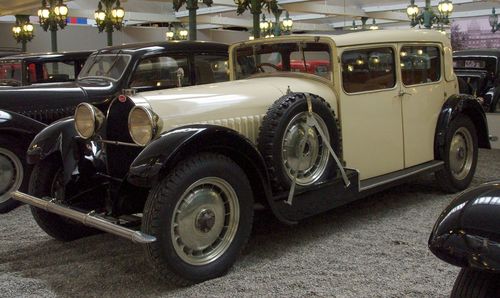
This car is in the Schlumpf museum in Mulhouse, apparently the largest car-museum in the world, with especially a large number of Bugattis. I think the combination of subtly drawn lines with the big wheels and thick-profiled tires is really beautiful. Million-Guiet is the name of the coach-builder. I once knew someone who owned a Bugatti 46, and was restoring it. On the outside the car was covered with dark red leather. I took this picture myself.
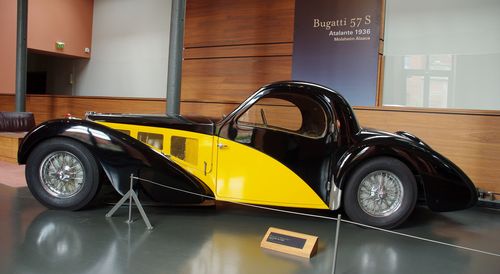
There's remarkably little space for the occupants. I think there's no space at all behind the chairs, not even for a small briefcase. I think the side window in the shape of a drop is very beautiful. This car is in the Schlumpf museum in Mulhouse, and I took this picture myself.
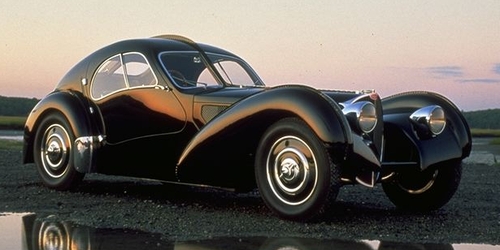
Another classical design. Only three of these cars were built. One (I think this one) is owned by Ralph Lauren, who once won the Pebble Beach Concours d'Elegance with it. An other also won the concours once.
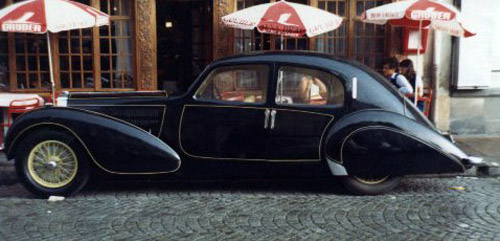
This car was ordered new by the Marquess of Cholmondeley, a regular customer of Bugatti's. I think the little sun-shades and the terrace make the picture extra beautiful, because they add something of a French feel to it. Figoni et Falaschi is the name of the (French) coach-builder. I stole this picture from the well-know Bugatti-site The Bugatti Page by Jaap Horst.
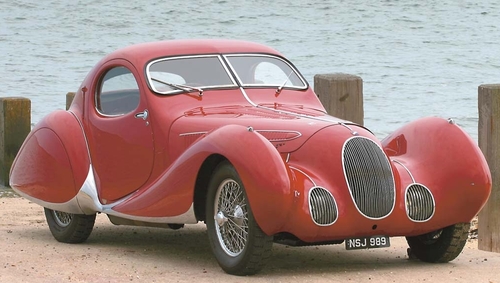
Such a voluptuous car. Talbot was a French car-brand, called Talbot-Lago from 1935 on. Also in Britain Talbots were made. These days these cars get sold for enormous amounts of money. Replicas of it are also being built (and this might just be a picture of a replica). Figoni et Falaschi is the name of the coach-builder.
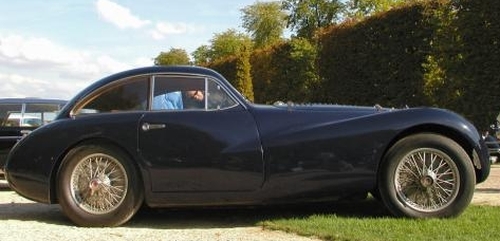
Isn't it beautiful? The subtle simplicity of its design attracts me very much. Chambas may be the coach-builder.
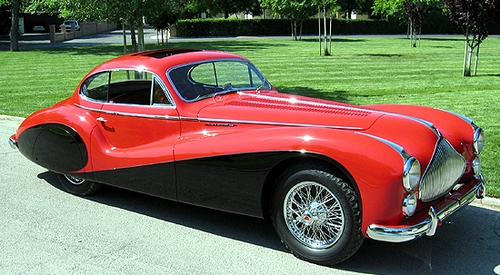
The front of this car looks so agressive but the rest looks stylish and slender. I used to be more interested in British and Italian cars and not so much in French cars as I am now (not taking Bugatti into account). But brands like Delahaye and Talbot-Lago have since acquired a high status, and on American websites are being offered for horrifying prices. Saoutchik is the name of the coach-builder. I stole this picture from the Blackhawk Collection, American car sellers.
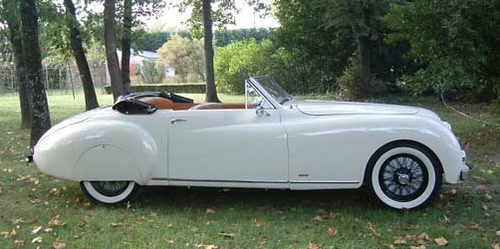
I think I understood correctly that Record is a special version of the type 26. Antem is the name of the coach-builder. But I could be wrong. If I were still twelve years old, I would have kept on reading and searching until I had the correct answer. Too bad about those ugly white-wall tyres.
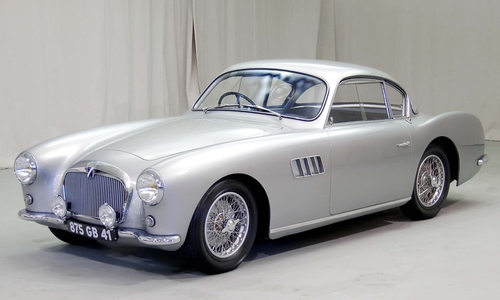
This car signalled the end for Talbot-Lago. It was way too expensive, and only a few dozen were sold. I stole this picture from Hyman Ltd., sellers of old cars. It's a nice website, with only beautiful pictures.
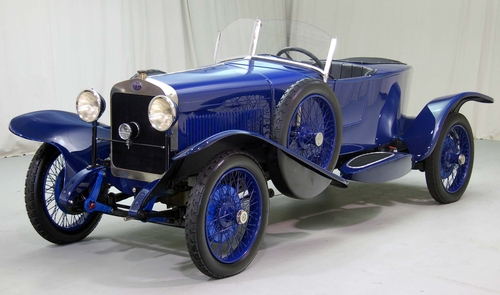
Delage was a French brand of automobiles, building luxurious and fast cars in Paris. This one is filled with nice details. The step between the front and read mud-guards for instance is, seen from the top, in the shape of a drop (which in this picture can hardly be discerned). This picture too comes from Hyman Ltd.
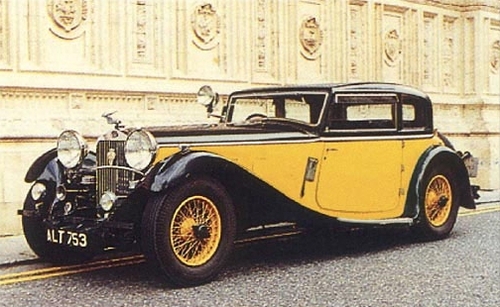
This car has a sturdy look (if that's the correct English word to use here). I think those big headlights are really beautiful. Note the big light next to the driver's seat. I guess the car was put here on purpose for the picture, with those bright yellow stripes on the street and the yellowish wall behind it. The design looks somewhat like that of this Jaguar SS 1 at the top of cars, page 2. Freestone and Webb is the name of the (English) coach-builder.
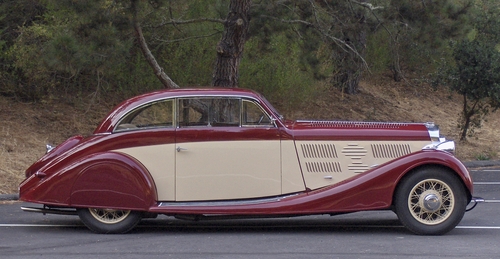
Large, yet slender. An impressive combination of style and power. Letourneur et Marchand is the name of the coach-builder. This one appears to be the only surviving example. I stole this picture from Bonhams Auctioneers.
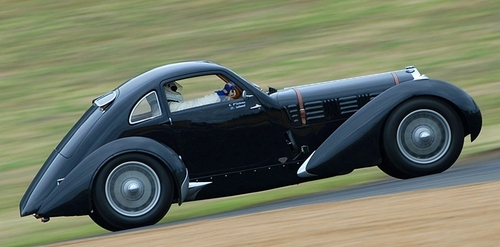
Gosh, how beautiful this one is. Note the leather strap over the hood, the door that opens backwards, the small fin-shape on the back and the small windows in the back that can be opened. Figoni et Falaschi is the name of the coach-builder.
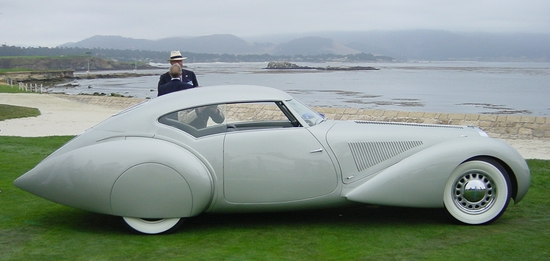
What a special, remarkable car. This car won the Pebble Beach Concours in 2005, which is where this picture was taken. Modernity from the thirties can be so beautiful. Pourtout is the name of the coach-builder.
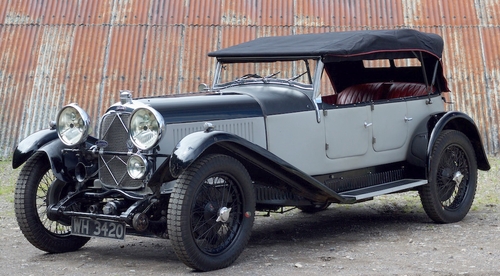
Lagonda was a British brand of cars that had its seat in Staines near London. It was taken over by Aston Martin in 1947. Quite an impressive automobile, also thanks to the angle this picture was taken from, the roof hanging over the wind-screen, and those high head-lights. I found this photo at Cotswold Collectors Cars.
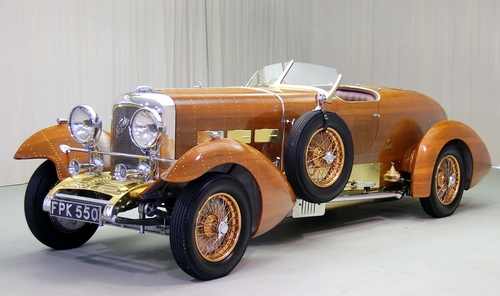
This automobile has an aluminium coach, entirely covered with wood (and brass). The wood is fastened to the coachwork, using thousands (!) of brass rivets. Nine 'boattail' Rapides were built with a body like this one (it has a tapering back with a brass end), only one of which, this one, is made of wood. This picture comes from Hyman Ltd. They asked a price of $ 650.000,-.
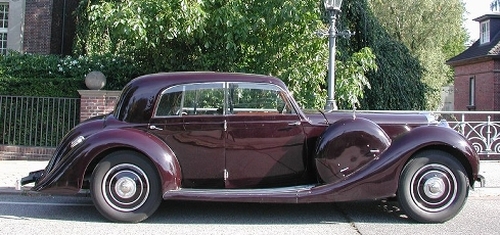
This automobile looks very chic to me, and I guess it is built on the same chassis and with the same engine as the previous one, above. I'm also very much charmed with the colour of this one. Note the knobs to open the hood for the spare tire with.
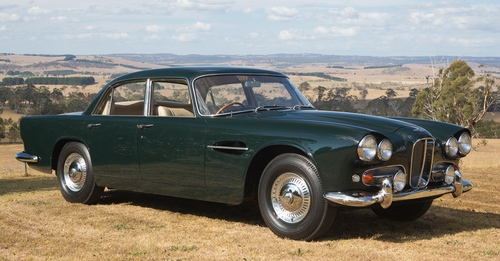
Now this is a strange car. Such an odd front. But it's got something. I think again (as with so many of the cars on these pages) what attracts me to the design is the combination of fierceness and slenderness. This model was an attempt by Aston Martin to revive the brand Lagonda. Afterwards the name Lagonda was only used for models made by Aston Martin. I stole this picture from Bonhams Auctioneers.
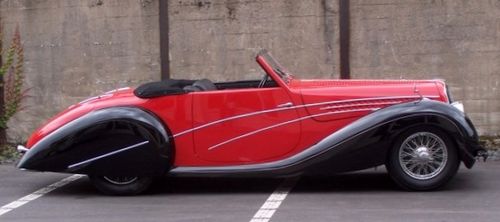
Delahaye was a French factory that built automobiles in Tours. In 1954 the brand was taken over by Hotchkiss. Automobiles built by Delahaye often had an extravagant look to them, and this one comes very close to it. But I am convinced by the luxurious look of it. I also very much like the colours, red with black beneath. Bonhams also sold this car once. They claimed it was built in 1947 and that the coachwork was done by Letourneur et Marchand. This picture is from E. Thiesen, car sellers in Germany.
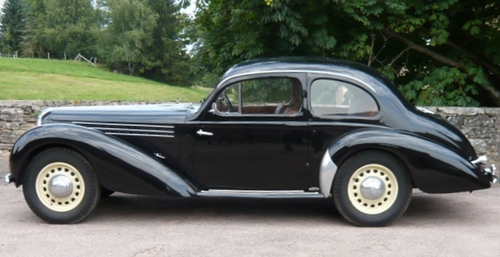
This Delahaye I think even has modest chic. A beautiful and unobtrusive design, with simple lines. Guilloré is the name of the coach-builder. I stole this picture from ACCLC, a seller of old cars in France.
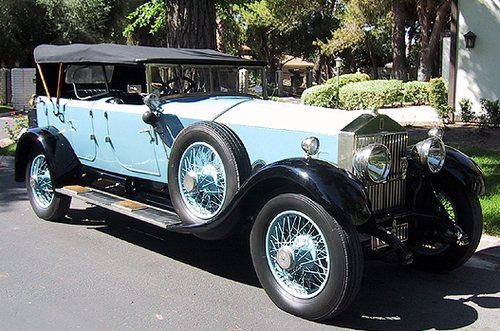
Rolls-Royce was a British automobile-factory, named after the founders of the firm, the gentlemen Rolls and Royce. Until the second world war the firm had its seat in Derby. Such a lot of work, a machine like this. So big and still slender and beautiful. In the years between the two world wars many cars were entirely built by hand, Rolls-Royces especially. Windover is the name of the coach-builder. Until 1959 Rolls-Royce did not build any coaches, but delivered all their automobiles as a driving chassis.
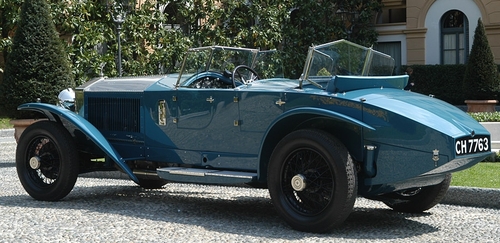
I very much like those wide mud-guards, and of course this striking back. The window for the passengers in the back can I guess be folded downwards, no exception in those days. I guess that Jarvis is the name of the coach-builder.
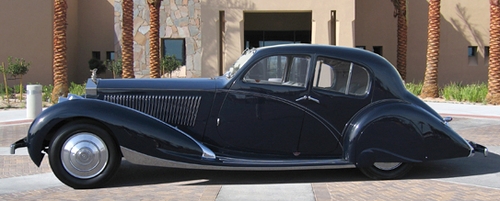
I think the way in which the car's major line slowly drops downward, beneath the side windows, is very beautiful. The first owner of this car was a prince of Nepal. Figoni et Falaschi is the name of the coach-builder. Pillarless implies that the doors open to eachother's opposite sides in one and the same door post. This picture is from Blackhawk Collection.
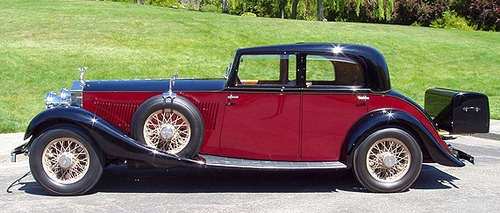
Park Ward is the name of the coach-builder, that during the years between the two world wars was the major coach-builder for Rolls-Royces. A beautiful, slender automobile with a trunk that protrudes strikingly far to the back. This picture is from The Auto Collections.
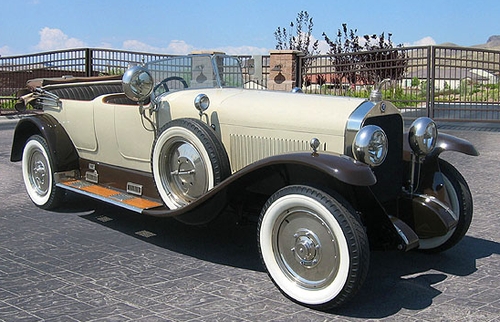
Isotta Fraschini, just like Rolls-Royce named after its two founders, was a famous Italian automobile-factory, with its seat in Milan (not Italy's automobile capital Turin). Cesare Sala is the name of the coach-builder. I stole this picture from Platinum Classic Motorcars, sellers of old cars.
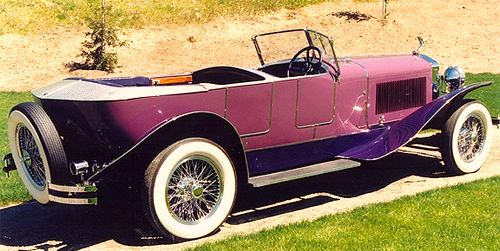
Oh, those colours. And the smooth forms of the mud-guards. The interior is also wholly in purple. Cesare Sala is the name of the coach-builder. I can't remember where I found this picture, but Hyman Ltd later had this car for sale too, and asked $ 550.000,- for it.
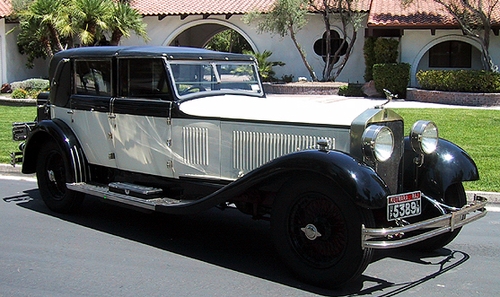
This automobile is a real colossus. It has a wind-shield that if I'm not mistaken can be opened. Its luxury fits the mansion in the background. Seemingly this car too has coachwork by Cesare Sala.


